Introduction:
Why does your mind never stop talking—even when you want peace?
Why do thoughts jump from past regrets to future worries without permission?
The answer lies inside your brain’s Default Mode Network (DMN)—the system responsible for overthinking, anxiety, and mental noise.
And here’s the breakthrough truth:
👉 Meditation doesn’t just calm the mind — it rewires the brain itself.
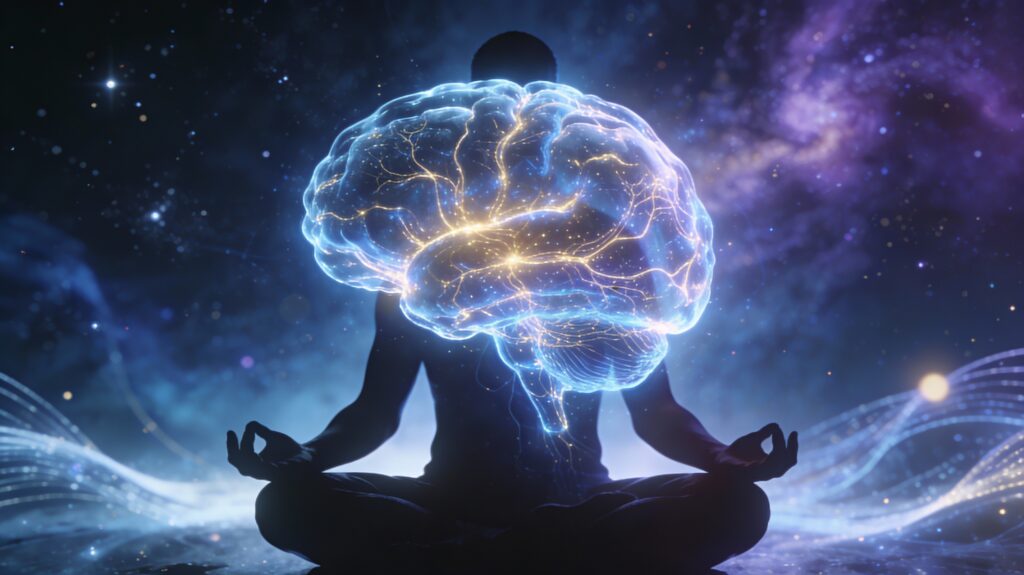
This guide explores how meditation reshapes your brain, silences the DMN, and helps you build a calmer, more focused, spiritually aligned life.
What Is the Default Mode Network (DMN)?
The Default Mode Network is the brain’s autopilot mode.
It activates when:
- You are not focused
- Your mind wanders
- You overthink
- You relive past memories
- You worry about the future
In simple words:
DMN = background mental chatter.
🔻 Overactive DMN leads to:
- Anxiety
- Stress
- Depression
- Poor sleep
- Emotional instability
🔑 Meditation is one of the only practices proven to reduce DMN activity.
How Meditation Rewires the Brain ?
Meditation shifts the brain from autopilot thinking → conscious awareness.
Here’s what happens biologically:
- 🧠 Prefrontal cortex strengthens → better focus & decision-making
- ⚠️ Amygdala calms down → reduced fear & stress
- 🔗 New neural pathways form → healthier thought patterns
- 🔕 DMN activity decreases → less overthinking
💡 Meditation literally trains your brain to stay present.
Scientific Proof: What Research Shows
Harvard University
- 8 weeks of meditation reduces amygdala size (stress center)
Yale University
- Experienced meditators show reduced Default Mode Network activity
UCLA
- Long-term meditators have thicker brain regions linked to memory & awareness
Clinical Studies
- Up to 52% reduction in anxiety
- Significant decrease in depression symptoms
- Improved sleep quality & emotional regulation
Meditation is not belief. It’s brain science.
Spiritual Meaning: Rewiring the Mind = Rewiring Life
Ancient traditions explained this long before neuroscience.
They called it:
- Samskaras (mental impressions)
- Karma patterns
- Energy conditioning
When the mind becomes still:
- Old emotional patterns dissolve
- Awareness expands
- Inner peace becomes natural
🕉️ Meditation clears the dust from consciousness.
Science calls it neuroplasticity.
Spirituality calls it awakening.

Why Meditation Is Essential in Modern Life ?
Modern lifestyle constantly activates the DMN:
- Screen addiction
- Multitasking
- Social comparison
- Information overload
- Chronic stress
Meditation acts as a mental reset button.
Benefits include:
- Calm nervous system
- Emotional balance
- Better focus
- Higher energy
- Spiritual connection
Long-Term Benefits of Meditation
- 🧠 Improved focus & memory
- 🌿 Reduced cortisol & stress
- ❤️ Emotional stability
- 😴 Better sleep
- ⚡ Increased energy
- 🧘♂️ Spiritual clarity & intuition
Top 5 Meditation Tools for a Modern Spiritual Life
🧘♂️ 1. Breath Awareness Meditation
Balances nervous system and quiets the DMN instantly.
🔔 2. Mantra Meditation
Uses sacred sound vibrations to calm subconscious noise.
👁️ 3. Mindfulness Meditation
Observe thoughts without reacting—builds emotional strength.
🎧 4. Sound & Frequency Meditation
Binaural beats and healing frequencies calm the brain.
✍️ 5. Journaling Meditation
Transforms mental clutter into conscious clarity.

How to Start (Beginner-Friendly Guide)
- Start with 5 minutes daily
- Same time, same place
- Focus on breath or mantra
- Let thoughts pass naturally
- Increase gradually
❌ Avoid forcing silence
❌ Avoid comparison
❌ Avoid unrealistic expectations
Conclusion
Meditation doesn’t change the world.
It changes how you experience the world.
When the Default Mode Network quiets,
your true awareness awakens.
This is where:
- Science meets spirituality
- Focus meets peace
- You meet yourself
Frequently Asked Questions
How does meditation change the brain?
Regular meditation is associated with changes in the brain areas involved in attention, emotion regulation, and self-awareness, supported by the brain ability to reorganise through neuroplasticity.
What is neuroplasticity?
Neuroplasticity is the brain ability to change its structure and function in response to repeated experience. Practice strengthens certain circuits while weakening others.
How long until meditation changes the brain?
Changes are usually gradual. Some studies report measurable differences after several weeks of consistent daily practice, but a few minutes a day is more effective than occasional long sessions.
What type of meditation is best?
The best type is the one you can maintain. Mindfulness meditation is the most studied, but loving-kindness, body scans, and focus-based practice also have research support.
Can meditation reduce stress?
Yes. Regular practice is associated with reduced stress, anxiety, and reactivity, largely through improved regulation and greater awareness of thoughts and emotions.
Comments
Share your thoughts — I read every single one.